Sunday, 18 February 2018

Beware Intolerance


Beware intolerance.

Last week Centre Parcs announced that it would no longer advertise in the Daily Mail and publicly apologised for any offence caused.

What happened?

One of the UK’s premier athletes, Tom Daley, a multiple diving world champion and multiple Olympic medallist, announced in 2013 that he was in a relationship with another man, Dustin Black. He joins many another famous and not so famous individual in preferring relationships with his or her own sex. Composers Ivor Novello (We’ll keep the home fires burning), Samuel Barber (Adagio for strings), Benjamin Britten (Peter Grimes) and writer Somerset Maugham all had lifelong stable relationships with male partners. Stable relationships involving deceased famous women are more difficult to find, but there are plenty of modern examples.  It’s that word “announced” that is recent.

Both Oscar Wilde, one of the finest exponents of both written and spoken English and Alan Turing, mathematician and father of computers fell foul of a law that persecuted homosexuals. That law was mercifully revoked at the end of the 1960s. Much more recently, same sex couples have been able to publicly declare their relationships and register them. This is turn has been followed by regular announcements from some public figures that they are either in a same sex relationship or at least wired in such a way that a future announcement in that vein is imaginable.

We move further.

Messrs Daley and Black recently announced that they were expecting a child. Whatever the mechanics of such an event might be, I very much doubt that either will give birth and the method, if any, by which DNA has been shared has not so far been, well,  shared, either. Let me make it clear at this point that I wish the two gentlemen and their progeny well: in my opinion, being a parent is both a wonderful gift and the most important job any individual will ever do. Obviously they both want that experience and that is a critical ingredient in being successful at it.

Enter Richard Littlejohn, who writes a column twice weekly in the Daily Mail. In his most recent column he commented on the impending arrival of the Black/Daley baby, supporting the idea of gay parenting, but offering his belief that the best option for a child was to be brought up by a couple in which both sexes were represented. The question that Mr. Littlejohn infers, I have been unable to find any research attempting to address.

Storm, outrage and opprobrium in bucket loads were heaped on Mr. Littlejohn and the Daily Mail by, amongst others, Centre Parcs and the South Bank Center. Hey-ho even the Stop Funding Hate pressure group weighed in; aren’t they in the realm of “we’ll kill anyone who’s for the death penalty”. Whatever happened to reasoned debate, not to mention Evelyn Hall’s “I disapprove of what you say, but I’ll fight to the death for your right to say it”?

It is worth remembering that without the ability to have a reasoned debate, in the 1960s, on the role of the state in an individual’s sexual orientation, homosexual men in Britain might still be facing Alan Turing’s fate of choosing between enforced castration or a prison sentence, rather than being able to announce imminent joint parenthood.

This episode should be a red flag. For organisations to punish individuals and other organisations for their beliefs is institutionalised bullying and a very big step on the road to making heresy illegal. And who amongst you will be the ones to define heresy? The Spanish Inquisition, the German Nazi party and Da’esh have tried and the end-game is always the same, the killing of innocents. Nice company you’ve chosen to keep, Centre Parcs.

Sunday, 26 June 2016

Brexit - what a mess


Well, that’s it then, all the rhetoric is over and the result is a Brexit. As the Chinese proverb says, beware of what you wish for – you may get it.

Now I know that we are all being urged to treat this as a “positive opportunity” and to “work together and work to heal our differences”. Yeah, right. The Scots are seeing as a “positive opportunity” to finally get their independence. The Irish are talking about a United Ireland. The Welsh are crying for the money they’ll lose from the EU and Yorkshire have realised that the development  money they were getting to places like Hull will also disappear A joke web-site for London to declare independence and stay in the EU got 30,000 signatures in just a few hours. As a Yorkshireman with Celtic roots I’m not proud of my country any more. No wonder the President of the European Commission, Jean-Claude Juncker, wants us to get out as quickly as possible.

Looking at the map, it is pretty clear that it’s the English agricultural areas and the needy development areas that produced the biggest “leave” support – and they are the ones that receive the EU subsidies. Worst of all there are so many “Leavers” interviewed on TV who are saying “I only voted 'leave' as a protest; I never thought it would happen”. For them, it must be like walking up after a drunken one night stand with an ugly bedfellow and a hangover. “Oh my God, what did I do?”

Having organised their postal votes, my children were in Spain and Germany on Black Thursday. My son has a small company with customers in Europe. His Facebook post read “I’m thinking of applying for political asylum” and my daughter “with a Spanish husband and Scottish mother, I have options”. Both of them are part of the wealth-creation class, doubtless they will be asked, no forced, to pay additional taxes in future to continue to provide the leaving areas with equivalent subsidies. There is no other way that the rebate to the NHS could be funded. And me and my wife? We live outside the UK, but pay UK taxes there which we can’t escape for reasons I won’t go into here, we rarely take any of the services offered to people of our age, as we are not here to do so: we woke up on Friday considerably poorer.

Of course there are those Bremainers clinging on to hope. A referendum is advisory, so, in theory Parliament have the right to reject it: very unlikely, but just possible. Since many were disenfranchised, like EU residents who have been living in Britain for a long time but have never applied for British Citizenship, since they didn’t need to – we belong to the EU and have signed up for the free movement of people – an appeal could be made (where, the European Court?) to enable them to vote retrospectively: hmmm, I can hear the screams from the Brexit camp already. Parliament takes on board the rerun petition and authorise another go, even have a best of three perhaps: in your dreams.

So, we are all going to have to live with consequences. Here are a few that I predict. Many of those pensioners living in France, Spain, Italy and elsewhere in the EU will discover their free health care there will no longer be available there, sell up and come back to the UK, putting pressure on the Health Service, so needing the illusory 350 million a week promised. The fall in the value of the pound will create higher priced manufactured goods in shops, this will depress the High Street and cause inflation at the same time, leading to higher interest rates, increased mortgage payments and so less money to spend: hence, we will see higher rents and increased unemployment. Some Europeans living here will go, particularly those in low paid jobs, requiring increased immigration from poorer non-EU countries to do the jobs that Brits won’t do. Scotland will leave the United Kingdom, so Hadrian’s wall will be renamed Farage’s wall as it is strengthened to keep out all those Syrian refugees shown on his poster streaming unchecked into the North. 

If you can feel anger coming through, you are right. Perhaps later I will start to see a plus side, but not today. All I see is a positive opportunity for damage limitation.

Friday, 17 June 2016

Leave or remain? What will leaving really cost?


Leave or remain? That’s what we Brits are being asked to decide on very soon.
Right now, it is almost impossible to turn on the TV or open a newspaper without seeing and hearing about Brexit and Bremain. Discussion programs dominate, with particular emphasis on the economy but, the strange thing is, there’s more passion than persuasive data. At the end of program, there’s a common audience complaint, “we still don’t feel we have enough information to make a decision.”  And about what? Well. the economy of course.

Amazingly, according to the website www.fullfact.org “There is no definitive study of the economic impact of the UK’s EU membership or the costs and benefits of withdrawal”, as the House of Commons Library says. So, no wonder there is such a dearth of information. Why no such study has ever been commissioned I have no idea but couldn’t help wondering if both sides feared the answer. Or perhaps no-one expected it ever to be needed.

Then suddenly it struck me, try to estimate it! Health warning: there are going to be some figures coming up.
 
According to the fullfact.org website, the UK net payment to the EU, after rebate, contributions to farmers and poorer areas, like Cornwall is £8.5 billion pounds a year, that’s eighteen in and nine and a half back. That’s about two pounds a week or a hundred pounds a year, each.

If we left, we’d get that back, but there’s a cost. Of course we’d still get access to the single market, but we’d have to pay tariffs on our exports to EU countries. The UK exports about £325 billion a year, of which 44% or £143 billion goes to Europe. The tariff charged is 4.7% to non-EU countries and so, if we became one of those we'd need to find  £6.7 billion annually.
There was a massive project called simply 1992 which was a collection of actions to ease movement of people, goods and money around Europe. The estimate was that it was worth over 1% of the GDP of each country, and the UK participated fully. If we leave, we'll lose that The UK’s GDP was a whopping £1.86 trillion in 2015, and that means that losing the benefits of project 1992 will cost us £18.6 billion every year.

What that shows is that we will have to pay something like £25.3 billion to get back our £8.5 billion, so, far from being better off, it will cost the country around £16.8. Numbers will billions in don't mean that much, but it translates to us all being to the bad, about 4 pounds a week each, every man, woman and child. Put another way, leaving Europe will cost every two children family at least £800-00 a year.

This analysis has been very simple. It assumes that we don’t lose a single European customer. We haven’t thought about what has to be sacrificed to find the tariff to keep the price to the European customer the same. Obviously that additional tariff cost has to be found and it can only come from profit, which hits investment, or cost, which means salaries or investment or parts, and we haven’t discussed the knock-on effects of those possibilities. We haven’t discussed the cost of “taking back control”, the Brexit camp scream about interference from Brussels, but haven’t talked about the cost of setting up or expanding the UK’s “independent” standards bodies. We haven’t talked about the cost of all those experts and consultants that will be needed to negotiate our relationship with Europe and all the additional civil servants needed to exercise that control that has been taken back. If all those are added in then 4 pound each figure will rise but by how much is speculation.
I want the UK to remain in Europe for us all to continue to be better off.

Monday, 13 June 2016

Travel broadens the mind ... if you can get through the red tape.


Leave or remain? That’s what we Brits are being asked to decide on, and very soon.

I’ve just finished applying for a Visa Waiver for my wife to visit her daughter & family in the USA. It’s called an ESTA and I could feel the will to leave sapping away as each page completed revealed another one to do. “They” wanted her name history, parental information, employment history, all current and previous passports, contact addresses and residential addresses. “They” declared that there was no guarantee of privacy before asking such questions as “have you ever been involved in genocide or drug dealing” (I felt like answering “yes, against flies and mosquitos” and “yes, I was a barman at Uni” but haven’t noticed a great sense of humour exhibited by homeland security) … and this is to waive the need for applying for a visa!

We’ve forgotten that travelling around Europe has become so much simpler and less bureaucratic with the EU. Show your passport and that’s it. But if we leave? At the end of my first year at University, I travelled a little in Europe. France (Paris), Spain (Barcelona) and Germany (Kaiserslautern) were all on the itinerary. Spain was not then part of the EU. French trains could not run on Spanish rails, and vice versa, as the gauge, (the distance between the two rails), was different in the two countries. Crossing the border between Spain and France took a good two hours.  We had to leave the train from Barcelona just before Perpignan, take our bags and passports through to French customs. Finally, when all passengers had gone through, we boarded another train and got on our way to Paris. Years later I took the same trip and on that second trip, I boarded a TGV at Barcelona Sants station, crossed the border without stopping, alighted at Gare de Lyon and walked straight to the Metro. Spain had joined the EU, so passport, customs, and border checks had been made redundant and Spain had at long last allowed standard gauge to be used for high-speed international trains – originally they’d built railways with a different gauge “to make it more difficult for French invaders to use the railways”.

As for health, no worries now as EU members have to offer reciprocal services. Something we would lose if we left the EU.

I want Britain to remain in Europe because I don’t want to waste hours and even days of my life filling in forms just to go on holiday or make a business trip. More, I’m sure there are better ways for my personal holiday and business travel budgets to be spent than paying for people to make travelling longer, more costly and more difficult.

Saturday, 11 June 2016

Leave or remain? War and Peace


Leave or remain? That’s what all us Brits are being asked to give our opinions on in less than two weeks’ time. This is the first of a few pieces where I’m offering my attitudes to the question – for what they are worth.

The biggest complaint that I see and read in the news and hear amongst friends and family is “we don’t have enough information, it’s not clear cut”.  

Let’s get back to basics. What brought about the EU in the first place?

Most of those voting in the coming EU referendum will not have any idea of what an absolute horror the European wars were even though they were regular occurrences for over a thousand years. And that, I firmly believe, is largely because of the existence of the EU, an organisation many of us are considering leaving. Now why?

Avoiding another European war was the idea that drove the visionaries of France, Germany, Italy and the Benelux countries to construct the Treaty of Rome – the foundation of the European Union. We Brits didn’t join for another twenty years, having turned down the opportunity of being one of the founding nations. Clearly we've been confused about Europe for a long time.

One of my early memories is holding my mother’s hand while walking across a bomb site in Sheffield. It seemed to my young eyes to stretch into the distance and on my right, there were three department stores and four clumps of twisted girders where another four had been. I think the three left standing were Marks & Spencer, C & A and British Home Stores; “Germany’s air force, the Luftwaffe, had mistaken the department stores for a steel factory” said my mum. Some years later I was walking with a German friend around Stuttgart; I noticed a rather odd configuration on top of a hill just outside the town “that’s where the RAF dropped their load on a bonfire, believing it to be the town” said my friend. Those two incidents happened in a war that seems as remote to most people as the Great War of a century ago seemed to me, but to my grandparents, the memories of that war were raw and real and perpetuated by fading photographs of lost brothers and cousins.

Anyone who’s read a history book knows Europe’s famous names. Here’s a few: Napoleon, Wellington, Bismarck and Nelson: they were all heroes blessed with a large helping of charisma. And they were warriors, first, foremost and above all.

The European Union has succeeded in its aim of avoiding war. How? By creating the foremost opportunity for continuing dialog, friendship, trade, travel and mutual support amongst nations that had previously regularly knocked six bells out of one another. It hasn’t thrown up many charismatic heroes though.

I want Britain to remain in Europe because I’d rather leave a safe Britain to my grandchildren and their progeny than the opportunity for them to become heroes and heroines.

Saturday, 8 August 2015

Farewell HMA Tom Fletcher from the BLBG.

On Tuesday, members of the British Lebanese Business Group (BL BG) gathered together for an address by the outgoing UK Ambassador to Lebanon, Tom Fletcher.

One of Lebanon’s top ten banks, Credit Libanais, generously offered to host the gathering in the sumptuous suit on the 29th floor of their new headquarters building: a glass enclosed terrace afforded wonderful views of Beirut stretching out into the Mediterranean in the evening sunlight. Chateau Bell-Vue had donated cases of two of their wines for the occasion. Many thanks to both organisations.

HMA Fletcher was introduced by Chairman, Graham Ball who then showed a short video of his recent “saying good bye to Lebanon” walking (yes, walking) trip of about 100 kilometers. His itinerary started from Hamat in the North, along the coast down to Beirut. It looked like a lot of fun with plenty of sampling of local produce, as well as touring the container terminal in a fork lift and visiting different points of interest. An imaginative and unique way of raising his hat in farewell to a country he has come to love.

A short address was followed by a lively and extended Q&A session. His Excellency reminded us that on his first meeting with the group, it had asked him to “fly the flag and we’ll do the business”; a combination that has resulted in British exports to Lebanon doubling to over half a billion pounds Sterling annually. His embassy have certainly flown the flag with the return of British Airways, arrival of Marks & Spencer and many, many other British brands gracing the malls of Lebanon. And then there was Great British week and the initiation of annual Business awards.


Many of the questions probed Tom’s view of the future and he remains fiercely optimistic for on his blog.

Lebanon. In support of that view he cited the potential presented by the offshore gas field, coping with the Syrian crisis and its attendant influx of refugees, coping with the presidential vacuum and the attendant government torpidity, coping with the issues of electricity shortages and indeed the Lebanese amazing capacity for coping.

He explained that he believes that Lebanon’s future should and must be in Lebanese hands and has urged political leaders to listening less to the advice and wishes of foreign governments and more to the wishes of the Lebanese people. It remains his hope that evolution will prevail and that his vision of Lebanon 2020 is achievable, if not necessarily by that date. Many of those views are developed further


The evening was closed with the BLBG presenting HMA Fletcher with an engraved box of locally made cheese serving knives.


Tom, the BLBG thanks you unreservedly for your support and wishes you and your family all you wish for from the future.


Graham Ball, BLBG Chairman. 

Sunday, 30 November 2014

BLBG meeting 25th November – “State of the Nation”


Her Majesty’s Ambassador’s annual address to the British Lebanese Business Group (BLBG) is eagerly awaited and usually results in the best turnout of the year. Last night, over seventy braved heavy rain in the dark to get to “the residence” in the hills above Beirut, and they were not disappointed.

Rather than stick to the tried and trusted formula of describing the regional political situation, HMA Tom Fletcher first described the successes of flourishing trade between the two countries. Annual exports from the UK are now running at well over the half billion pound mark, with Scotch salmon, Scotch whiskey, high end yachts, British Airways and Perkins engines getting special mention. There has also been a dramatic increase in UK brands on the Lebanese High street, Lush cosmestics have just opened their third branch here for example. An historical parallel was drawn between the Phoenicians, (the old name for the Lebanese), and the British as maritime trading nations.
 
He went on to talk about increasing links in many other spheres before drawing inspiration from a recent Lebanese invention for measuring the human body’s vital signs. Worn on the wrist, the “Up”, as it is called, measures heart rate, number of steps taken, breathing rate etc. before regularly uploading them to a handy iPad. The rhetorical question posed was what would such an instrument show if put on Lebanon’s hypothetical wrist. Still alive and functioning but in need of external support was the net of HMA’s view.

The whole event was fueled with excellent canapés, some using one of Scotland’s exports mentioned above and lubricated, if one wished, with the other one, or, of course, with Lebanese wines.

An excellent evening, lively, informative and fun.

So, you had a bad day!

Yesterday the bad decisions started early. The first one was to get up at all. No, it wasn’t Friday the thirteenth, I hadn’t walked under a ladder or strayed across the path of a black cat or cut my nails the day before (Thursday for losses).  Given the myriad superstitions that my mother and grandmother had, I must have transgressed at least one and probably more.

The first discovery was that a document had gone missing. Desk turned upside down, draws and cupboards inside out for a half hour or so – nothing. OK, back track through when last seen and the little video in my head revealed a foggy image of a colleague picking it up at a meeting the previous day. I called him and, sure enough, “oh, I just borrowed it, I’ll bring it to the pub tonight and give it you back”. Great.

Later I set out for what I hoped and expected would be an enjoyable session of cards. The bad decision?  To take a quick power nap before leaving. Tournaments start at five, but at that time, I was still sitting fuming and fretting in an almost endless traffic jam. Late and stressed is not the way to succeed at anything and so it turned out, enjoyable as it was. Oh, and a “power nap”? It’s shorter than a “pensioner’s nap”.

And now to the pub. Warning! Bad decision coming, I took the car (no, that wasn’t it) to my usual parking lot in Hamra and let the car jockey do his stuff for me (that was it!).  Convivial Friday night atmosphere, lots of friends and acquaintances and the list retrieved. Happy hour slipped by. “let’s move on to another place down the road, cheap drinks, plenty of atmosphere and loads of history, it was open before and during the war”. “OK, let’s go”. A snap decision, and a bad one. If I’d left then, disaster might have been averted. Great atmosphere and time ticked past. Walked back to car park and waited for the car jockey to find my car key.

I became aware of pockets being turned out, tins emptied and cupboards searched. There followed a hurried conference between the car jockeys. Cars were then searched one by one and after half an hour they admitted that the key had been lost.
Now what use is a car without a key? I had no choice but to leave the car and get a taxi home. Now we’ll see if not going back until morning was another bad decision.
And when I got home, I realised that the retrieved document had gone again too, left somewhere while the key was being searched for.

Better to have stayed in bed.

PS today is better, car retrieved with spare key and document found in car.

Thursday, 28 August 2014

40 Things I wish I’d know when I arrived in Lebanon

Introduction

It started as twenty and then grew as everyone I spoke to had a different view. With the resources for finding answers, it’s a bit more than forty, but never mind. It’s split into four lists. The first three are issues and differences that have affected people enough to justify their inclusion here. The final list is a set of resources to help you find answers to questions posed and so to cope successfully with an experience we all hope will be both rewarding and fun.

Many thanks to all who contributed and commented; this could not have been done without you. Special mention is due to Anthony, Francois, Harriet, Mark, Paul, Richard and Simon. Any gaffs or errors of omission are mine.

The advice I got was “don’t touch Arab (sic) pride and don’t touch Arab women”, but I’d already married one and my coach knew that! Hopefully this is a little more helpful.

One last thought before the "beef" - Lebanon has been my adopted country for over fourteen years, and I enjoy Lebanon, largely due to the fact that there are lot of Lebanese in it. Publishing lists like this risks offending or worse, so rather than take offence at anything, perhaps you'd write back to me with your views on foreigners instead. I promise to consolidate them all into another little piece.


Political and Cultural

  1. The political make-up of Lebanon is very complex, try to get some feel for it before coming here. Many seasoned MENA veterans find Lebanon so totally different from what they have been used to in the GCC or other Levant countries.
  2. Lebanon is unpredictable.  Trying to plan everything in advance - as one does /is accustomed to doing in the UK - won't work here.
  3. Bureaucracy Rules.  When dealing with any official entities, expect delays, bureaucracy and the need for "wasta" – it really is who you know and not what.
  4. You won't learn Arabic living here.  Most Lebanese speak English and/or French and, when learning that you are a foreigner, will practice their own language skills on you.
  5. The postal system just doesn't supply a reliable delivery/mail service. More, no financial nor business transaction can be sent in the mail, e.g. bank statements must be picked up in person
  6. Time management – Many Lebanese seem to have little idea of time which can give the impression of a lack of respect for your time especially if you come from a culture where time is sacrosanct. A consequence is that you are seldom expected to be on time.  An invitation to dinner at 8.00pm may well mean 9.30 or 10.00 pm, except during Ramadan, when you are expected to turn up as the sun sets and not a moment after.
  7. Most Lebanese operate on short time horizons. This makes them appear spontaneous and can be appealing but in a business context tends to lead to short sighted decision making
  8. Many Lebanese attempt to multitask in way that appears (and often is) chaotic and unproductive. They find it hard to give you or anything their undivided focused attention for any length of time.  This is not intentionally disrespectful though it can appear to be at first sight. For example, if their phone rings or an SMS arrives during a meeting with you, they will usually break off and take the call.  Equally, they will not be concerned if you do the same.
  9. Because of trying to do several things at once, they will often appear rushed and harried, they will rush through work (repairs and the like), any finished or repaired product should be closely inspected before accepting it.
  10. Useful tip – NEVER change your plans in reliance that a Lebanese will do something when they say they will e.g. arrive to fix your plumbing (this is especially true of handyman types - plumbers, electricians etc).  It will be far less irritating to continue to do whatever you were going to do and agree a time when lateness or non-appearance will not matter to you
  11. Lebanon is a Mediterranean country with a typically relaxed lifestyle – this manifests itself in ways that can be charming or infuriating depending on context and occasion
  12. Law enforcement starts with good intentions but quickly becomes lax. Traffic lights are more for illumination than anything else and a recent smoking ban in restaurants and pubs was steadily relaxed for various groups, which now seem embrace diners and drinkers! 
  13. You will need a "Plan B" for everything, from sourcing electricity (there is not enough electricity, so all locations undergo daily power cuts to “power share”, so you need access to another source, either your own generator on a balcony, or, for example purchasing extra power from a bakery!) to telecoms to access from and to the country.
  14. Bribery and the expectation of it exist. Get your coping strategy ready.
  15. Warning to all British males! There is a surfeit of ladies, so acquiring a Lebanese wife has proved a much more common hazard than many realize and has afflicted all professions. Diplomats, bankers & engineers have all fallen.

Starting to live here, you and your family

  1. How to find and rent an apartment, what to expect to pay and whether it’s worth buying
  2. How to buy/rent a car
  3. How to get a work permit 
  4. How to get a residence permit, how long it takes and that you won’t have your passport during that time
  5. How to get a driving licence.
  6. How to register a car in your name and do the annual MOT and road tax
  7. How to do temporary importation of cars, and maximum allowed age of imported cars
  8. How to clear personal effects through Customs and how much it should cost.
  9. How to or get an appointment with a doctor and how the medical system works
  10. How to cope with motor bikes, who can go and do whatever they like, as the traffic laws and rules don't apply, indeed in any accident, a motor cyclist cannot, by law, be blamed
  11. Security and armed people are everywhere in Beirut along with visible military vehicles and cordons – do not be alarmed, this is normal, best to ignore it
  12. Driving techniques are very aggressive and can be alarming but do not be too concerned, most drivers are highly skilled and in any case, because of the poor road system and numbers of vehicles, speeds are slow. The last thing most drivers want is to have an accident, they will do all they can to avoid one.
  13. If you get lost in Beirut, the mountains will be to the East of you – the mountain ranges in Lebanon run broadly North to South, and the sea to the West
  14. The 300 metre rule – you can buy almost anything or service you can dream of within 300 metres of where you currently are – your challenge is to locate the shop.
  15. Where to send the kids to school
  16. Where to shop for food/clothes
  17. Where to go out at night/for the day
  18. How much to pay for a taxi as there are no meters. As in many countries, taxi drivers exploit foreigners. At the Hariri Airport arrival floor, take the escalator up to the departure terminal and there, taxi drivers will happily greet you and accept LL20,000 for a ride to central Beirut because they've just dropped off a ride
  19. Internet speeds are lower than in the UK so, for example, Skype interviews are very difficult to conduct.

 In business

  1. Types of company and corporate structure that exist (SAL, SARL, JV etc.
  2. How to form a company and what percentage of shares can be foreign owned
  3. Positions foreign nationals are allowed/not allowed to take up in a company
  4. How much is a reasonable retainer for a lawyer and auditor
  5. You, your staff and company will spend at least 20 days of the year not working due to the huge number of public holidays, many of which are announced at the very last minute.
  6. Compared to Western operating practice, decisions have to be referred to a higher level, and everybody is afraid to make a one, whether in a private organisation or government, and a corollary to this is …
  7. Management Style – most Lebanese rely on Prestige and Face, their management approach (especially but not limited to older people) appears dictatorial and “control freakish” to people more attuned to western management styles. They greatly value age and experience (sometimes to a fault), they also have a respect and admiration for anything foreign (such as you).
  8. The Lebanese are extremely family oriented. Many businesses are still family owned, so criticism of family members, even if richly deserved, is not wise in virtually all cases. As a new employee, even in a senior capacity, expect to be excluded from all important decisions  
  9.  … and if you are working with the government, Lebanon spends long periods (up to a year) without one, during which time, no new law can be passed. Only Belgium has spent longer without a government this century
  10. The consequence of the previous fact means that those working in ministries spend long periods unable to do anything much for the future, affecting motivation and level of interest in what you are trying to achieve.
  11. Employment law is a minefield; get a brief before hiring anyone.
  12. There are no green paper consultative documents produced, salaries increases have been imposed twice in the last five years with little warning, for example. This makes cash flow and P&L planning both tricky and essential!

Top resources

Books and Publications

  1.  “At Home in Beirut” published by Turning Point, stocked by Libraire Antione chain, this is an excellent reference which can be the first point of call for almost all the business and living questions
  2. HSBC Bank, British friendly with simple to/from UK transfer facilities
  3. Country Risk Review and Lebanon This Week published weekly by Byblos Bank, both are publications packed with regional wide numbers that actually mean something. You can access the latest on their web-site’s media section.
  4. British Embassy UKTI, the current head is Paul Khawaja and he knows everybody
  5. Local staff and colleagues if you’re lucky enough to already have them
  6. “The Daily Star” an English language newspaper
  7. Libancall – an approximately English language breaking news SMS service
  8. The British Lebanese Business Group, for contacts and networking
  9. Naharnet website, a news service covering the region in general and Lebanon in particular
  10. Five Index for finding suppliers of just about anything
  11. The Duke of Wellington pub’s Friday night “Happy Hour” and “The Greedy Goose” pub for meeting other ex-pats
  12. Henry Heald for shipping/customs/etc. They’ve been doing it since 1837 (!) and again are British friendly.

Video clips:

  1. Middle East Airlines are the national carrier; their in-flight entertainment has quite a good advertisement for Lebanon, showing shopping, restaurants, hotels, clubs, cosmetic surgery, beaches and ski resorts. This is a shortened version.
  2. And if you want to get a touristic look, here’s a quick tour of some of Beirut’s landmarks.


Monday, 11 August 2014

How Isis makes me feel


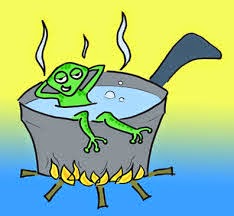
Drop a frog in hot water and it will immediately leap out. Put the same frog in cool water and slowly heat it and it is likely to remain until cooked (and dead!).  We humans have a similar characteristic; we have no difficulty spotting emergencies and responding; storms, earthquakes and heart attacks spring to mind, but a slow steady yet inexorable build up we may well fail to notice until too late – history is littered with examples, the consequences of underestimating the Nazi threat springs to mind.

For part of my working life I was responsible for developing strategies for business. I discovered this was not about sitting in a darkened room with a wet towel round my head trying to think clever thoughts, but was about identifying important trends as early as possible, that is, finding those things whose rate of increase was interesting while the absolute volume of activity was still small. The explosive growth of personal devices and the internet were apparent over thirty years ago, you just had to know where to look to find the ancestors of Google, Skype and mobile phones already up and running. I missed texting though.
This type of analysis is applicable at any level, and there are three international trends that are really worrying to me. Global warming: we aren't going to spend any time on it other than to point out that we haven’t really got past the awareness stage, in other words, there is still no concerted effort at world level to cope with a world problem. The second is the steady erosion of the effectiveness of antibiotics, those miracles of modern medicine that we abused in such cavalier fashion that there are an increasing number of resistant bugs: again there is little evidence of any kind of concerted world action to ensure they are used correctly. Finally there is the increasing growth of tribalism and its sinister brother sectarianism. Far from there being any worldwide action against this trend, there seems to be a concerted effort to reinforce it.
Let me try to justify such a sweeping statement. The Basques have been making noises about separation for years, the Catalans have managed to get there language revived, the Scots have campaigned for “independence” for years and are actually being given the opportunity to secede from the three centuries old Act of Union and the Irish are, well, the Irish.
This is not personal, most of my genes are from the Celtic fringe (Scots, Welsh and Irish) and my grand-children are half Catalan. More, I’ve been on a lifetime journey of personally "celebrating difference". This was partly by chance and partly because I passionately believe that the search for truth and knowledge are facilitated by variations in culture and experience. I also believe that two of the mainstays of human success as a species are our power of co-operation and our capacity to challenge established ideas; for evidence, just look at the number of multi-cultural, joint Nobel Prize winners. And, of course, for that to work to the optimum, tolerance is essential.
It is against that back-drop that I find the growth of ISIS and its atrocities against people and cultural and historical icons, the events in Nigeria, particularly the school kidnap and more recently the mass killings of civilians in Gaza to be abhorrent and personally, psychologically disturbing. They all have a common element, complete intolerance for any point of view other the narrow, entrenched and didactic one of the perpetrators. It’s as if the worst of the Spanish Inquisition had been re-incarnated and deposited in the Middle East with 21st century weapons put at their disposal.
From here we can only go in one of two directions. Like a pond freezing over, which starts in a corner and finishes with the whole surface becoming ice, we can all retreat to our tribes and expel those different from ourselves, as was done in Nazi Germany and is happening now in Northern Iraq and Syria and Nigeria and Sudan and will inevitably spread. Or, we can take world action to counter the threat.


While the wonderful advertising campaign for unity being waged by the Lebanese army on local television is a positive example, I can’t say that that the responses to global warming and antibiotic misuse give me much hope. So, let's speak up and speak out.

Friday, 7 February 2014

Med Poets Plunder Party

“Shiver me timbers!”
“Have him walk the plank!”
“No, keel haul him!”
“Where’s the rum?”
“Ooooh arrrrrr!’’

What’s all this then? Extracts from a resurrected “Pirates of the Caribbean”? A celebration of the so-called generous vowels, not to mention generous Rs (pronounce with care) of the West Country?

No, these are extracts from entertainment at the Med-Poets’ Society’s annual offbeat get together, an event that somehow combines elements of a varsity comedy club “smoker”, a masquerade ball of the type favoured by long gone European Aristocracy and a good-old fashioned East End “knees up”. More succinctly, it’s an opportunity to dress up and perform a party piece with identity hidden by costume and alcohol, with community singing and dancing to follow.


Many thanks to all those involved in this years’ gathering, billed as a Pirate Plunder Party. All proceeds go to charity, so sponsors were signed up (were they threatened with those traditional Pirate Punishments, I wonder?), Alt City in Hamra, Beirut was found as the new venue which was an improvement on the now defunct Hard Rock café, a DJ employed, a source of really good British fish ‘n’ chips found and tickets sold. There’s no committee, just a wonderfully energetic and enthusiastic organiser by the name of Vicky. Some of us get dragooned into doing silly things under the watchful eye and humorous introductions of Anthony, the master of ceremonies to jolly us all along on the night. At this point, word plays on the “Jolly Roger” (the famous skull and crossed bones pirate flag) spring to mind, but I’ll leave you to work those out for yourselves.


My own silly things at past events have included writing and reading my own nonsense poems, playing a guitar and being interviewed with a gorilla;and I still had to pay for the tickets, I told you Vicky was a wonderful organiser. This year I just borrowed a disguise. And thoroughly enjoyed the whole thing. Plans to move on to a second event fell by the way side as a quiz, a fancy dress competition, eating, dancing and drinking carried on until after mid-night.

Anyone who hasn’t been asleep for the last year knows that things are, well, err, sort of, like, a bit difficult here. One of the neighbours (Syria) has got rather noisy and the rowdy behaviour has spilled over into parts of Lebanon. And that has rather inhibited fun and frolics, as it seems (and would be) thoroughly insensitive to have a plethora of celebratory events going on while bombs keep going off. So we’ve been without the usual Christmas balls, while New Year and Burns’ night have just whimpered past. But this one was for charity and a little lifting of the spirits was sorely needed.

Thanks to Vicky and her volunteers, we got it.

Wednesday, 5 February 2014

Why did he do it? The Celtic curse?

There are days when it seems the universe was set in motion for the sole purpose of creating situations and events that make me feel angry or frustrated or miserable and on really bad days, all three at once.

Monday was one of them.

I wake up when it gets light, something my body learned to do to overcome jet lag. A wonderful trick it is, as on my first trips to New York I used to wake up ready for breakfast at two every morning and then have difficulty not falling sleeping over dinner. My longtitude sensing body clock works fine – as long as there is no early morning cloud cover. Early morning Monday’s sky was pretty well clouds and nothing else so I woke up late, which makes a bad start as something (my regular swim on this occasion) has to be cut out of the schedule for the day.  Another bomb went off, this time in Choueifat with the by now familiar, yet still gut-wrenching images on the TV. A set of trivial things I won’t bore you with continued to go awry so that, by early evening, the world had gone black and turned against me and I was completely unfit for human consumption. So I consumed instead.

Now that same day I’d read of the circumstances of the death of one of my favourite actors, Philip Seymour Hoffman, at the ridiculously early age of 46. Seventy bags of heroin were found stashed in his flat. His mother bore an Irish name (O’Connell) and I began to wonder about the problems of us Celts, our apparent tendency to self-destruct while trying to escape from a world that can make us revolt from even having to stay on it. William Hamilton (mathematician), Oscar Wilde (writer), Dylan Thomas (poet), Brian Jones (musician), Richard Burton (actor) and George Best (sportsman) were all Celts who paid the ultimate price for over indulgence in sex, drink or drugs (and again sometimes all three) often presumed to be attempts to escape from reality. All of them provided insights and pleasure for the rest of us without finding personal peace and now they’ve been joined by another.

What is it about the Celts then? Well I can’t be sure, but Monday provided me with yet another experience of descending into the black followed by switching the lights out. And there’s another colour that can engulf me – red. I think of myself as easy going, I like the soft furriness of cats, I’m normally gentle with others and their feelings, but, and it’s a big but, very occasionally the red mist descends.

I think it was the manager’s fault. He should have ducked when, having ripped out the SIM card and crushed it under foot, I threw the empty phone across the shop. The details of the event don’t really matter, suffice it to say that what seemed like hours of my life had been wasted by a customer dis-services screw-up by a well-known mobile telephone company in the UK. One by one, all the pet hide behinds of data protection, health and safety and “it’s our policy” had been trotted out for my mental torture. Then it happened, the red mist that I’d been holding back finally exploded all over my brain anaesthetising good-sense, reasonableness and physical caution, during which time the phone was made to fly. My wife smoothed over the threat of assault charges, but I’m still banned from ever going in one of XXX’s shops again. Just the sight of me walking past the same shop half an hour later caused the manager to duck. Too late. I think it was that that caused the feelings of remorse, guilt and self-horror to set in.

It happens every five years or so, the invasion of the red mist followed by descent into black. Black alone perhaps once every few months. I can cope with that, but if they happened regularly? I’d have been pushed or fallen off the stage ages ago.

So I’m not going to blame Messrs. Hamilton, Wilde, Thomas, Jones, Burton, Best and Hoffman for leaving too early,  for I suspect they’d had to cope not just with the black and the red but many other colours too and all too regularly for comfort. I’ll just thank them for the bodies of work they, and so many other Celts, left behind.

Sunday, 15 September 2013

Another crisis draws to a close

Phew, it seems that the Syrian crisis is over. Well the Syrian chemical weapons crisis, not the whole thing, but, as school reports used sometimes to say – a good start.

For a time, it seemed that the clock had been turned back to the cold war era, with Russia and the USA locked in a stand-off. I started to put some words down towards the end of August and wrote some criteria for testing possible solutions, they were these …

“First any action must be credible to the citizens of those countries taking action, and that can only happen if international law supports that action. That is a necessary, not a sufficient condition as events in the aftermath of the 2003 Iraqi invasion showed.

“Next, to be credible to citizens of this region, the Middle East, in general and Syrians in particular, any action must be aimed at improving the situation of the victims of the civil war, whatever side they are on. Killing them or their relatives won’t meet this criterion.

“Further, it should be sufficient to prevent any future use of chemicals on civilians.”

I must have been feeling a bit down about things because I then wrote …

“Can the circle ever be squared? It can’t. Talk of crossing red-lines was fine as a threat, but now the Western world has got itself into the position of a parent who tells an unruly child that he’ll be in serious trouble if he steals chocolate biscuits from the fridge, only to discover that the packet of Hobnobs is finished and the child denies all knowledge of it. Some action has to be taken to preserve parental credibility. But what?”

Hmmm. Thankfully I got that one wrong. Actually the answer was sitting there in the analogy, no more chocolate biscuits, or in this case no more chemical weapons. Simple really, not only does it satisfy all three criteria, but by neutralising stocks of Sarin and whatever other noxious agents have been manufactured, the world at least feels a safer place to live in.

Being British, I would like to think that the decision by our dear old Parliament not to authorise military action made some contribution to allowing time for more creative solutions to percolate through. Why, incidentally, are these high flown international activities important to me? Well, I live here in Beirut and it seems that if Syria catches a cold, Lebanon is usually in danger of getting pneumonia.

Does it matter, as some local pundits suggest, that the idea is a Russian one? Not one iota. As noted elsewhere, good ideas are highly promiscuous, they really do not care who has them. What does matter is that an approach has been found that is acceptable to the international community and espoused by local governments. The sight of Messrs. Lavrov and Kerry clearly enjoying each other’s company on stage makes me hope that the relationships forged in the heat of this crisis may be brought to bear on other difficult issues later on as well.


Because although the most recent crisis seems to be drawing to a close, one thing we can be sure of – there’ll be more before we’re done.

Thursday, 4 July 2013

Oil and Gas for Lebanon - BLBG June 2013


June’s BLBG meeting had a different format from the usual. A panel of three comprising David Friedman, Oil & Gas industry (O&G) analyst, Niazi Kabalan, International projects lawyer specialising in O&G and Nick Wilson OG analyst discussed the geology, politics and practicality of Lebanon’s potential fields. All lived up to their billing of experts in their field. Questions and answered flowed for a good hour before the panelists were allowed their well-earned trip to the bar. The following is my memory of what was said, any errors and omissions are mine not theirs.

The first message was clear - the fields are potential ones. Until drilling starts and some hydrocarbons found and analysed there is hope, there are probabilities and there is, well, potential. Whatever the papers and the politicians say, discovery is still in the future and thus not yet assured; riches can only follow discovery. OK, then when does drilling start?

The area of the Mediterranean that is Lebanon’s has been divided into 10 zones. Leading Oil companies around the world have been invited to submit documents showing why they should be considered for test drilling. Once that process of review, known as pre-qualification has been completed, there will be a short list of companies (albeit fairly long) who will then be asked to bid for the zones. There will be winners (and of course losers) in that process, one for each zone. Each zone winner then starts the agreed drilling and we wait for the screams of joy. Now it needs to be remembered that the seabed is one and half kilometres below the surface. The potential fields are some six kilometres below that, getting there is difficult and that means expensive; estimates are currently around $40 million per well and each zone could have ten or more test wells drilled. That translates into finding companies willing to risk half a billion dollars for, at worst, nothing. And if there is something, that’s not without risk either as BP found in the Bay of Mexico.

The good news is that there’s no shortage of companies trying to make the short list. Lebanon is seen by many as more attractive than Israel (no-one wants to upset the Arab world where there’s a lot more already discovered Oil and Gas), Cyprus (no-one wants to upset Turkey), Egypt (prices are capped at a very low level) or Syria (for obvious reasons). The not-so-good news is that until Lebanon has a fully-fledged, as distinct from caretaker, government there is no power to sign the contract engaging the winners nor, for that matter, is there a power in place to even decree how the bid process will work.  There is a Lebanese O&G advisory board, which in turn has a staff of professional advisors, with responsibility to draw up recommendations of who and how and what the contracts might look like, but the advisory board needs someone to advise. The hope is that the bidding process will complete before the end of this year. Watch this space. And hope. Because as soon as the drilling starts, even if nothing is ever found, some of that investment money will flow into Lebanon for engineering, travel, catering and all other the various support functions that will be needed.

How much might be out there? The top estimate is thirty trillion cubic feet of methane. That translates, at current prices to paying off Lebanon’s debt and having perhaps twenty-five thousand per head to invest. That sum may go even higher if the gas is what’s known as “wet”, i.e. has butane, propane or even oil fractions mixed in with it. However, the finds so far in Israel and Cyprus are “dry”. While that number is not in the same league as the millions that Qatarians expect, the Lebanese are twenty times more numerous and the Qatari reserves so far found are, perhaps, thirty times bigger. But there’d be more enough to sort out the travel, electricity and water issues facing this country.


So what does this net out to? Lebanon has to sort out a government and then implement the already decided approach (which is to follow the Norwegian model). Then the gas has to be found. It won’t make the Lebanese rich, but it could dramatically improve the infrastructure of the country. Watch this space. And hope.

Friday, 14 June 2013

Machines have feelings too

If you think your home appliances have no feelings and are simply inanimate lumps of plastic and paint with a few wires and bits of metal, think again. They seem to want attention and get jealous, with dire consequences, if too much court is paid to one over another.

Let me start at the beginning, always a good place to start if a little unimaginative. For reasons best known to my wife, redecoration time was declared last Friday. With her usual approach to turning thought into action the decorators arrived on Monday morning, paint, thinners, brushes and masking tape having spent the weekend arriving like eager guests at a party.

The first rebellion was from our central air conditioning system, which began to make groaning and creaking noises sounding just like it was in real pain and of such magnitude our next door neighbour beseeched us to turn it off before disaster struck. As if in sympathy the plan “B” AC began blowing out warm air only. Service men arrived and performed the machine equivalent of major surgery on the main one “cash, please”, but only the last rights were possible on our so called Little AC – replacement required.

Then it was the turn of our faithful old gas hob; imported from a refurbished flat in England, it had never really been able to digest the local propane gas properly, in spite of replacement nozzles, burners, connections and such like. One of its burners finally went out, so another set of men arrived to fit a new one. Bigger and better it may be, but many a good meal has come from that old hob, now gone for a third life in the home of Mohamed the decorator.

Our fridge freezer clearly mourned the loss its friend across the way and wanted attention, so the fridge stopped cooling and the freezer iced up. Another service man, another part replaced and another bill paid “cash, please”: attention duly delivered.

As an aside, services here are extremely responsive. The cooker hob and air conditioning unit were delivered and installed the day after purchase, the decorator came to give a quote and then started immediately after negotiations were completed, “cash, please”; the fridge repair man was at the door fifteen minutes after the mayday call. But (oh, yes, there’s always a “but”) they tend only to bring their hands with them – “do you have a hammer/screwdriver/pair of pliers/junction box/drill bits/dust sheets”  – all those have been asked of us in the last week. Since DIY stores are difficult to come by, I am amazed to be able to say the answer was, in all cases, “yes”.

Was that it then? Oh, dear me, no! I don’t really think of us as technology freaks: OK, we have a couple of laptops, a PC, an iPad, a couple of iPhones, streaming video and music piped around the house from iTunes, but that’s about par for the course these days isn’t it? The whole thing relies on the internet and, given the vagaries of the electricity supply, the clever bits of electronics that whizz bits and bytes into, out of and all around our flat are protected by a black box which smooths out all the electrical lumps and bumps as Electricity du Liban (EDL), the generator on the balcony and our local bakery dance around one another taking turns to supply us. The black box is known as an Uninterruptible Power Supply or UPS for short. The UPS resented being moved from of its hideaway in order to give the decorators free access to the wall behind it, and became an UIPS – an Unreliable and Interruptible Power Supply. Off to the menders for twenty-four hours, “cash, please”.


Perhaps foolishly we exposed our modem and routers to the power sources directly. “It’s only for a day”, we told ourselves, “it should be all right”. It wasn’t. They did what we all do when our proper sustenance is suddenly cut off, they got all grumpy and sulked. They just refused to pass on the bits and bytes to their usual proper places. We spent an hour while resetting and reloading was going on, in the waiting room of our internet service provider, which was rather like being in a dentist’s waiting room but with fewer comforts and more anxiety. Going in person was the only way to get them to help with the mix of boxes we’ve wired together over the years.

The series of hiccoughs and failures listed above looks unbelievable, but they all did happen in the last week, like some collective mechanical epidemic. The only machine that carried on working happily all through was the bank’s cash dispenser across the road, presumably delighted with the increased attention it has been getting.

Now, if you’ll excuse me, I have to go out, let’s hope the car hasn’t noticed …….

Wednesday, 12 June 2013

The British are coming

Almost directly opposite where I live there’s a “Commercial Centre” with names like “Clean House” (a cleaning service), “Jump and Slide” (a gym for kids) and “Christine’s Clothing” (a clothing shop, nothing quite like stating the obvious).  Friday means happy hour at the Duke of Wellington pub, watering hole of the Brits here and also at the Greedy Goose which tends to be more Irish orientated. Where am I? Surprise – West Beirut. It makes a bit of a change from the al-Maroush and al-Dar restaurants, flanked by Halal shops in the Edgware Road. In all fairness, I nod thanks to our American cousins, who with Hollywood and the internet, are also in there pushing the English language, and I have to smile at the “Duke of Wellington”, named after the hero of Waterloo, and this a francophone country.


But things go deeper than just the name of the shops and bars. Jaguar is, and has been for years, a favourite mark here, jostling with BMW, Mercedes and Chevrolet, so the imminent launch of Jaguar’s “F” series is eagerly awaited. British Airways have bought back the London-Beirut route from Lufthansa and earlier this year upped the number of flights. Marks and Spencer are opening in Downtown Beirut next month, with a fashion show to launch it (the first I've been to). Tescos are back in here via a local supermarket chain – does “good food tastes better at Spinneys” sound familiar? McVities’ Hobnobs, Walkers’ shortbread, Whiskeys galore and smoked salmon are part of the Scottish contingent. Oh, and yesterday I listened to Virgin radio (just started up) while driving (in my Swindon made Honda) to Beirut’s most famous Hotel, the Phoenicia, (part of the Intercontinental Hotels PLC chain) to have lunch with a friend (a senior executive at HSBC). I could go on, but I won’t, so apologies to any brand that feels passed over, but lists get boring in the end and the point is made, I think.

Why is this? I’m not an economist and this is not intended as a research paper, but let me just speculate a bit. Most of my recent ancestors worked in those industries spawned by the industrial evolution; a steel-maker, two cutlers and a shipbuilder have passed their genes to me, but not the industries. Most have headed to the Far East (the industries, not my ancestors), painful losses that have left a legacy, though, of Brits finding what they’re good at, doing it, selling it then shipping it off by sea. The Lebanese have been great traders, and that means buying good stuff and selling it on, Beirut wasn’t one of the Silk Road’s great ports simply as an accident of geography. So, there is a natural symbiosis, a set of points of contact, albeit at a distance. Add to that the catalysts of language, noted above, and the five year long stagnation in Europe making extending markets essential and I think we have some if by no means all of the reasons for the increase in British brands here.


I have a long running duel going on with some Lebanese friends about British cuisine with good natured banter as the weapon of choice. Try as I might to persuade them of the rich delight of venison stew (“oh no, you eat Bambi”), that wonderful combination of zest and fruit and pastry called Bakewell tart, the savoury luxury of beef Wellington (“that’s French”; with a name like that – yeah right), the angelic simplicity of Yorkshire pudding and that meaty winter warmer, Lancashire hot-pot, all I get back are comments about fish ‘n’ chips. But who knows, Pontefract cakes may be next on the list; come to think of it, Tescos might be shipping them already.